VAILS

VDOM AI Learning System. A single binary: interactive REPL, REST and WebSocket surfaces, LLM orchestrator, Prolog and ontology engine, CP-SAT solver, autonomous agents — all reachable from the VVL language.
The origins of VAILS
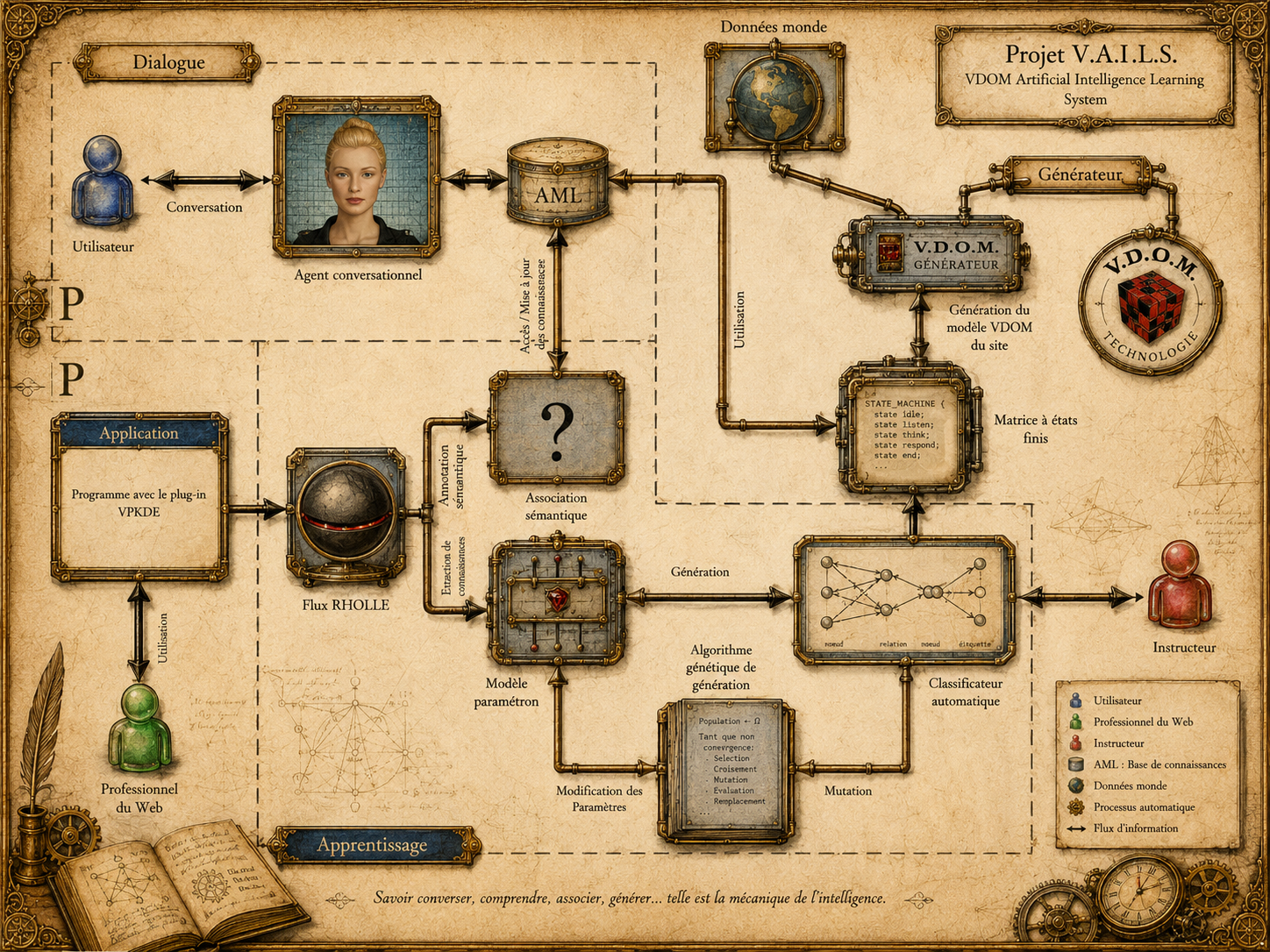
The origins of VAILS go back to a line of thought begun in the 1990s on neural networks, language and the mechanisms of intelligence. After studying text-generation systems based on semantic graphs, Nicolas Korboulewsky developed in 2006 the W.H.O.L.E. technology — Web Hyper Object Linking and Embedding — meant to model and learn the relationships between concepts.
On this foundation V.A.I.L.S. was born — VDOM Artificial Intelligence Learning System —, an architecture combining learning, dialogue and content generation. Long before the rise of Transformer models, VAILS already rested on a single intuition: intelligence arises from the growing complexity of the relationships between pieces of knowledge, and from their capacity to self-organize.
Even today, we reinvent the wheel on every AI project — for lack of an artificial-intelligence server, where any project already has a database server. And for lack of a language able to manipulate semantic concepts natively, in direct contact with the symbolic. That is precisely what VVL does.
It is thanks to this new kind of server that we can finally move to the true creation of native AI applications.
Seven subsystems, under one roof
The VAILS server unifies under a single memory the layers once scattered across microservices, scripts and notebooks: core, distributed, knowledge, compute, agents, vapp and voice. Run it as a REPL, a .vvl script, a daemon, over REST or WebSocket — depending on the chosen surface.
Interactive REPL
Read-eval-print on two languages. Step-by-step trace, switching with :vvl / :prolog.
REST API
Any VVL endpoint becomes HTTP. :gateway on opens a public tunnel for demos and webhooks.
LLM orchestrator
Connected to providers (OpenAI, Anthropic, local). Order-insensitive memoized cache, retry with ~>. In jev mode, the Jev decision model first decides typed decisions (~0.4 s); the LLM takes over when it hesitates.
Prolog engine
First-class. obj-assert projects any VVL instance into facts. The LLM ↔ OO ↔ Prolog triangle.
Ontology system
37 builtins. Typed schemas, priority rules, infer-fixpoint, ephemeral worlds with auto-restoration.
CP-SAT solver & planning
A VVL subset compiled to OR-Tools. 12 body forms, 3 decision types, why-infeasible diagnostics; planning:* DSL (tasks, resources, horizon, geo).
Autonomous agents
Three levels of autonomy: generated lambda @, ReAct loop [agent], multi-agent orchestration [architect] — ~99% of generated code syntactically valid. In jev mode, the [agent] judge and the [architect] validations go through Jev.
Server automations
Optional modules: signed PDF/Factur-X, Office COM, OCR & vision, Selenium, Gmail/Calendar, MCP & plugin connectors, ProSuite/Tekitisy/VDOM clients.
Distributed compute cluster
A master keeps the fingerprint-addressed code, the jobs and the leases; workers pull shards, verify the code and run it in an isolated VM. Recovery, draining, audit and hot backup are part of the protocol.
Native VM
A Rust virtual machine executes the pure subset of the language. Every compiled program exposes its coverage: what runs natively, what falls back to the host — the cluster's entry condition.
Smart contract ledger
A transactional ledger built into the server: every contract call is a chained, signed block (SQLite, Ed25519). [ledger:verify] replays the whole history; cluster replicas re-execute and attest it; the admin console shows blocks, state and anchors.
VScript & signed plugins
Sandboxed embedded language (modernized VBScript, Tier 1/3) callable via [vscript "..."]; external extensions signed with Ed25519 and a chain of trust.